This review discusses the relationship between mental health and financial wellbeing, showing how each can exacerbate the other. Those with mental health problems often face financial difficulties, while financial struggles can contribute to deteriorating mental health. The interplay is termed a “vicious cycle”, compounded by the double stigma surrounding these issues. Understanding this connection is crucial for addressing the challenges individuals face in both domains.
Money and mental health are “inextricably linked”.1 Individuals with mental health problems are more likely to experience financial difficulties, and individuals with financial issues are more likely to experience mental health problems. The two problems feed off one another, which can create a vicious cycle of increasing financial problems, and worsening mental health that is difficult to escape.
This review brings together evidence on what we know about the relationship between mental health and financial wellbeing. It looks at: 1) what sort of difficulties individuals with mental health problems face; and 2) what the relationship between mental health and financial wellbeing looks like.
People with mental health difficulties face several challenges.
Financially:
Non-financially
The relationship between mental health and financial wellbeing is complex. It has been described as “toxic”,15 a “vicious cycle”16 and a “downward spiral”17 with the negative nature being attributed to the double stigma of financial and mental health challenges.18
The image below helps to visualise the “vicious cycle” where the two forces, mental health and financial wellbeing, aggravate each other reciprocally.
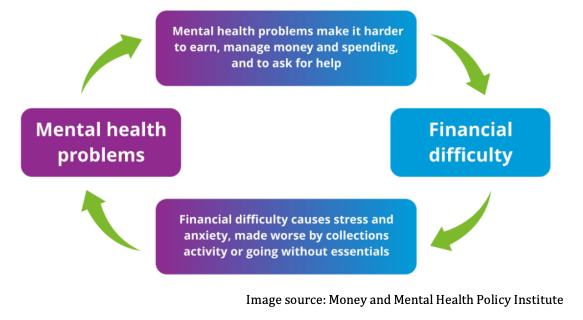
Image source: Money and Mental Health Policy Institute
Another way of visualising the relationship is the double helix model, pictured below. The two strands of the helix represent mental health and financial wellbeing, whilst the forces of social drift and social causation19 pull or push the strands together or away from each other.
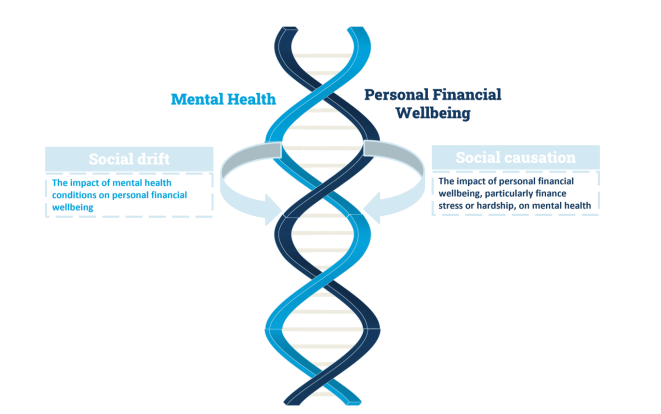
Research highlights two important concepts that are key to understanding the relationship:
The two concepts are closely related, and the individuation of finance can be extremely harmful as it reinforces negative feelings of personal blame and inadequacy,20 and feeds into the “double stigma”.
However, overall, the mechanisms by which mental health affects financial wellbeing, and vice versa, are not well understood, and this area needs further interrogation.
Did you find this review helpful? We would like to know what you think. Please contact us at [email protected] with your feedback, and any suggestions for further research or evaluation that should be included in future updates.
We would like to thank the Centre for Personal Financial Wellbeing at Aston University for their contributions to our thematic reviews within the mental health space.
Aston University, ‘Money and Mental Health Rapid Evidence Review’, July 2023
The Money and Pensions Service, ‘Mental Health and Financial Wellbeing’, 2018
The Money and Pensions Service, ‘UK Adult Financial Wellbeing Survey 2021 Mental Health Report’, October 2022
Bond N and Preece G, ‘Not a Secondary Issue: preventing and resolving financial difficulties for people in secondary mental health care’, March 2022
The Money and Pensions Service, Personal Finance Research Centre and the University of Southampton ‘The intersecting impacts of mental ill-health and money problems on the financial wellbeing of people from ethnic minority communities’, January 2023
Heartward Strategic, ‘Money and Mental Health’, August 2022
Office for National Statistics, ‘Cost of living and depression in adults, Great Britain’, September 2022
